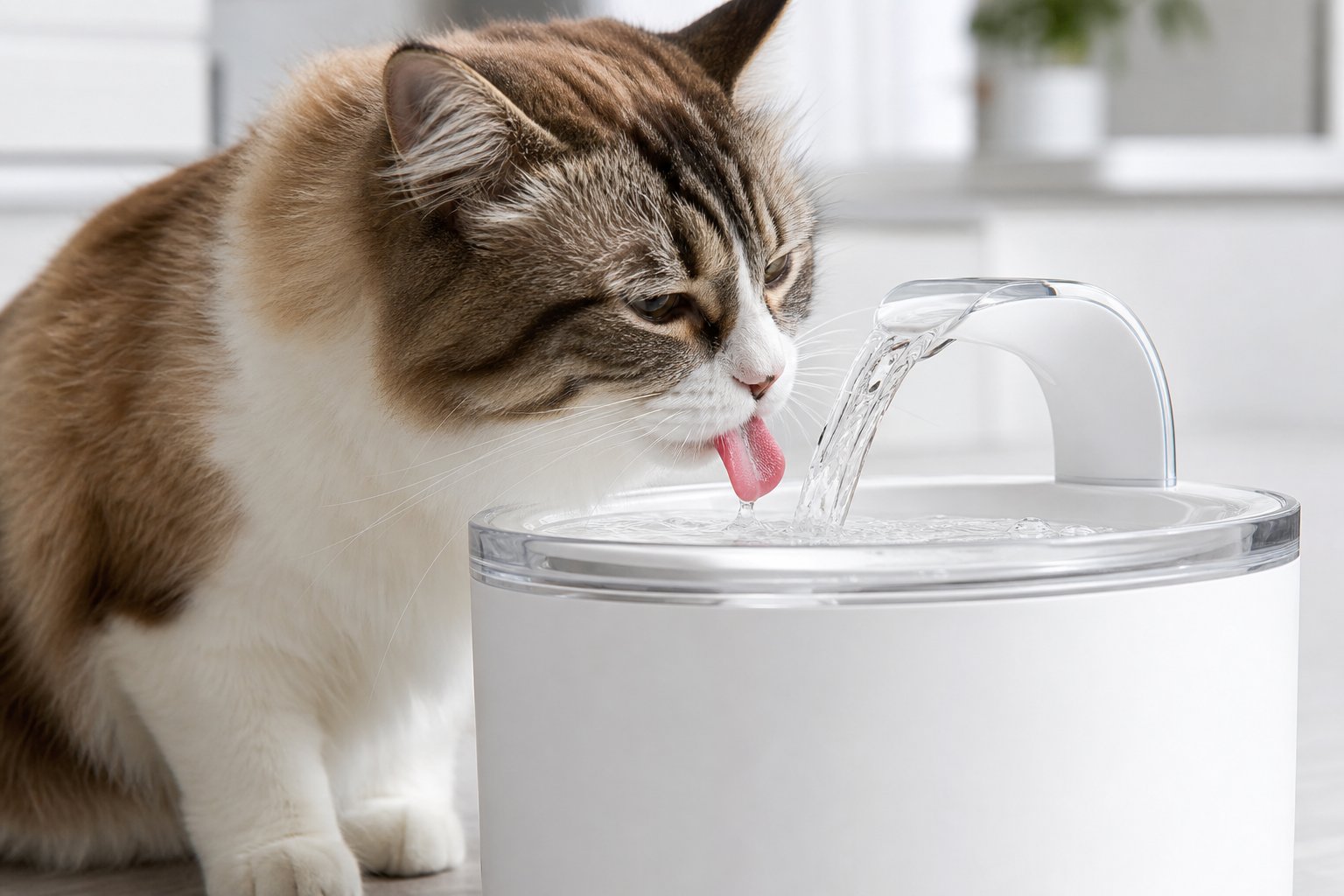
Why pet fountains fail early: pump, water-level and noise details behind return rates
- Most “stopped making a sound” or “stopped working” complaints point to the pump rather than the electronics. Choosing a pump means choosing a major driver of the return rate.
- Mainstream designs use 5V/12V brushless DC magnetic-drive pumps. Vendors quote 20,000–30,000-hour life, ceramic shafts to reduce wear and noise at or below 35–40 dB. These are manufacturer ratings; verify the finished unit rather than treating them as measured product results.
- Dry running is a leading cause of pump failure. Low-water power-off protection is one of the most valuable functions to verify, both on samples and on each production batch.
- At a factory audit, ask for per-batch powered aging records, including the stated 24–72 hours and 45–85°C test conditions, and noise measurements with a decibel meter on assembled units. Confirm that the aging conditions are suitable for the specific design rather than treating a datasheet promise as test evidence.
- Filters are consumables with an after-sales role. A four-stage cartridge, clear replacement reminders and spare pumps available through the service channel all affect whether buyers place a second order.
Pet fountains are among the lowest-priced smart-pet devices and among the categories most exposed to returns. The fault is often neither the electronics nor the app, but the pump: it grows louder, clogs with scale, or runs dry after the owner is away for a week. Buyers describe these failures in one-star reviews: “loud after a month,” “suddenly stopped working,” or “my cat will not go near it.” Each points back to a pre-shipment decision: which pump to use, what protection to include and how to test it. This guide examines the supply-chain details behind fountain reliability and turns them into checks you can carry out at a factory audit.
1. The pump is the product: what the ratings mean
Open up mainstream pet fountains and a familiar design appears: most use a 5V or 12V brushless DC magnetic-drive pump. Brushless construction removes carbon brushes as a wear item; magnetic drive couples the motor and impeller through a magnetic field rather than a directly connected, sealed rotating shaft, removing a common leakage path. Vendors quote service lives of around 20,000 to 30,000 hoursfor this pump class, with aceramic shaftto reduce wear, and rated noise at or below35–40 dB, while newer designs claim levels below 30 dB.
Read these figures with the right qualification: they aremanufacturer ratings—results from the pump maker’s own life tests under specified conditions, rather than third-party certificates for your finished product. This does not make them meaningless; it makes them a design limit whose conditions you need to understand. Every fountain RFQ should ask: Which pump manufacturer and model is installed? What life and noise ratings does the manufacturer publish, and under what test conditions? How does the assembled product, rather than the bare pump, perform on the bench? A sourcing partner who can answer all three with datasheets and batch test reports is worth discussing further.
2. Dry running: a leading cause of premature failure
Ask pump engineers what usually ends a fountain’s service life and the answer is rarely old age. It isdry running. When water falls below the intake, the pump spins against air and residue instead of a water film. Friction and temperature rise, and a pump rated for tens of thousands of wet hours may be damaged by hours of dry operation. Cats are unforgiving witnesses too: an empty bowl teaches them to find another water source, so the failure harms both the product’s reputation and the pet’s drinking habits.
The countermeasure islow-water power-off protection: the device senses water level, cuts power before the pump runs dry and restarts after refilling. This function can determine whether the pump has a chance to reach its rated life. Verify it twice. First, on a sample: run the fountain, remove the water supply and confirm automatic cutoff within seconds followed by a normal restart after refill. Second, in production: check that low-water protection is included in the standard test. In our QC procedure it accompanies the 24–72-hour powered aging test; protection fitted only to a retained sample does not protect production units.
A two-minute audit check: run the fountain normally, remove the pump from the water or drain the bowl, and observe its response. A protected pump should stop quietly within seconds; an unprotected pump may continue running dry until you intervene. Ask whether the cutoff is implemented in hardware or firmware. Either approach can work, but the answer helps reveal how thoroughly the team considered the failure mode.
3. Water path and cartridges: the purpose of four-stage filtration
The water path surrounds the pump, and its design affects how the unit ages. Our 2.5L platform uses a reservoir made from Tritan—a BPA-free copolyester widely used for pet water tanks—and water passes through afour-stage filter: a coarse layer that catches hair and dust to protect the impeller, activated carbon for taste and odor, a resin layer targeting dissolved minerals, and a final fine screen. The sequence matters: catching mechanical debris first helps prevent premature blockage of the adsorption layers.
The filter also links product strategy with after-sales revenue. A saturated cartridge restricts flow, which buyers may interpret as a failing pump. A filter plan is therefore part of return-rate management. Put three things in place: replacement cartridges genuinely available in the destination market, clear reminders in the manual and app, and a pump designed for real use—hair, scale and an occasionally missed filter change—rather than laboratory conditions alone.
4. Noise: what 35dB at the bowl means
Noise is a quiet reason for returns in more than one sense. For this pump class, manufacturers commonly quote levels at or below35–40 dB; our finished-unit specification isa measured level of ≤35 dB—checked per batch with a decibel meter on assembled products in normal operating mode, alongside power-consumption measurements. The gap between a rating and an actual reading is where complaints arise: a resonating cable clip, a slightly tilted pump pad or an intake vortex can produce a hum that no datasheet predicts.
This matters beyond return rates. Cats are particular drinkers: the promise of fresher moving water and better hydration loses its appeal if the bowl itself frightens the animal. A squeal at pump startup or audible motor cycling can teach a cautious cat to drink from a dripping tap instead. An RFQ cannot specify a cat’s comfort, but it can specify the mechanisms behind it: noise measurements on assembled units and vibration-isolated pump mounting that survives transport.
5. How to test the pump during a factory audit
Take this table to the next factory audit. Initial checks can be carried out on the shop floor within a day; the full 24–72-hour aging test requires its complete duration or review of completed batch records. Together, these checks address failure modes that lead to returns.
| Check | Test method | Acceptance evidence |
|---|---|---|
| Powered aging | Confirm the stated 24–72-hour powered aging protocol and 45–85°C conditions, and verify that those conditions suit the actual design and agreed test specification. | Batch aging records with the sample size, rather than a single retained-sample certificate |
| Noise measurement | Measure assembled units in normal operating mode with a decibel meter | Finished-unit reading ≤35 dB, with results recorded per batch |
| Low-water power-off protection | Remove the water supply while the unit operates and observe the response | Automatic cutoff within seconds; normal restart after refill |
| Pump identification | Ask for the manufacturer, model and ratings; cross-check the installed component | The 20,000–30,000-hour rating and ceramic shaft are traceable to the pump manufacturer’s datasheet |
| Water-contact materials | Request material documentation for the tank and water-contact parts | Tritan (BPA-free) tank; traceable food-grade material batches for wetted components |
| After-sales spares | Check the availability of spare pumps and replacement cartridges | Spare stock throughout the warranty period—12 months for our platform |
Table 1 — Pump-focused factory audit checks. Rated figures come from the manufacturer; measured results come from production-batch QC.
QC questions to send before the audit
- Which pump manufacturer and model are used? What service-life and noise ratings does the manufacturer publish?
- Is low-water cutoff implemented in hardware or firmware, and is it covered by the batch test procedure?
- What are the aging duration, temperature and sample size? Can you provide records from a recent batch?
- How is noise measured: which instrument, operating mode and test object—assembled product or bare pump?
- What are the four filter stages? Are replacement cartridges and spare pumps available in the destination market?
- What does the warranty cover, for how long, and who pays the replacement freight?
Frequently asked questions
Can 20,000–30,000-hour pump ratings be trusted?
These are manufacturer ratings, not third-party certificates, derived from the pump maker’s life tests under defined conditions. Treat them as a design limit. In actual use, dry running, scale and maintenance habits often determine service life before bearing wear does. Ask which manufacturer and test conditions support the number, then verify performance through your own aging tests.
Should the fountain specification be 35dB or 40dB?
First ask how the figure was obtained. This pump class is commonly rated at or below 35–40 dB; the important evidence is the batch reading on assembled units, in normal operating mode, taken with a decibel meter. Our specification is a measured finished-unit level of ≤35 dB. The gap between a rating and a measured result is where noise complaints arise.
How can I check low-water protection in two minutes during an audit?
Run the fountain normally, then remove the water supply. The pump should cut off automatically within seconds and resume after refill. Ask whether the cutoff uses hardware or firmware, and confirm that this behavior is included in production aging procedures rather than checked only on a retained sample.
What tends to fail in the second month of use?
Consumables and use habits often matter more than electronics: saturated filters restrict flow, hard-water scale forms on the shaft, and reservoirs run dry while owners are away. Address both the product—low-water cutoff, a cleanable water path and visible replacement reminders—and the supply chain, with spare cartridges and pumps for after-sales service. Put both into the QC agreement.
For the fountain platform specification and examples of batch aging and noise records, pleasecontact usto request them.